
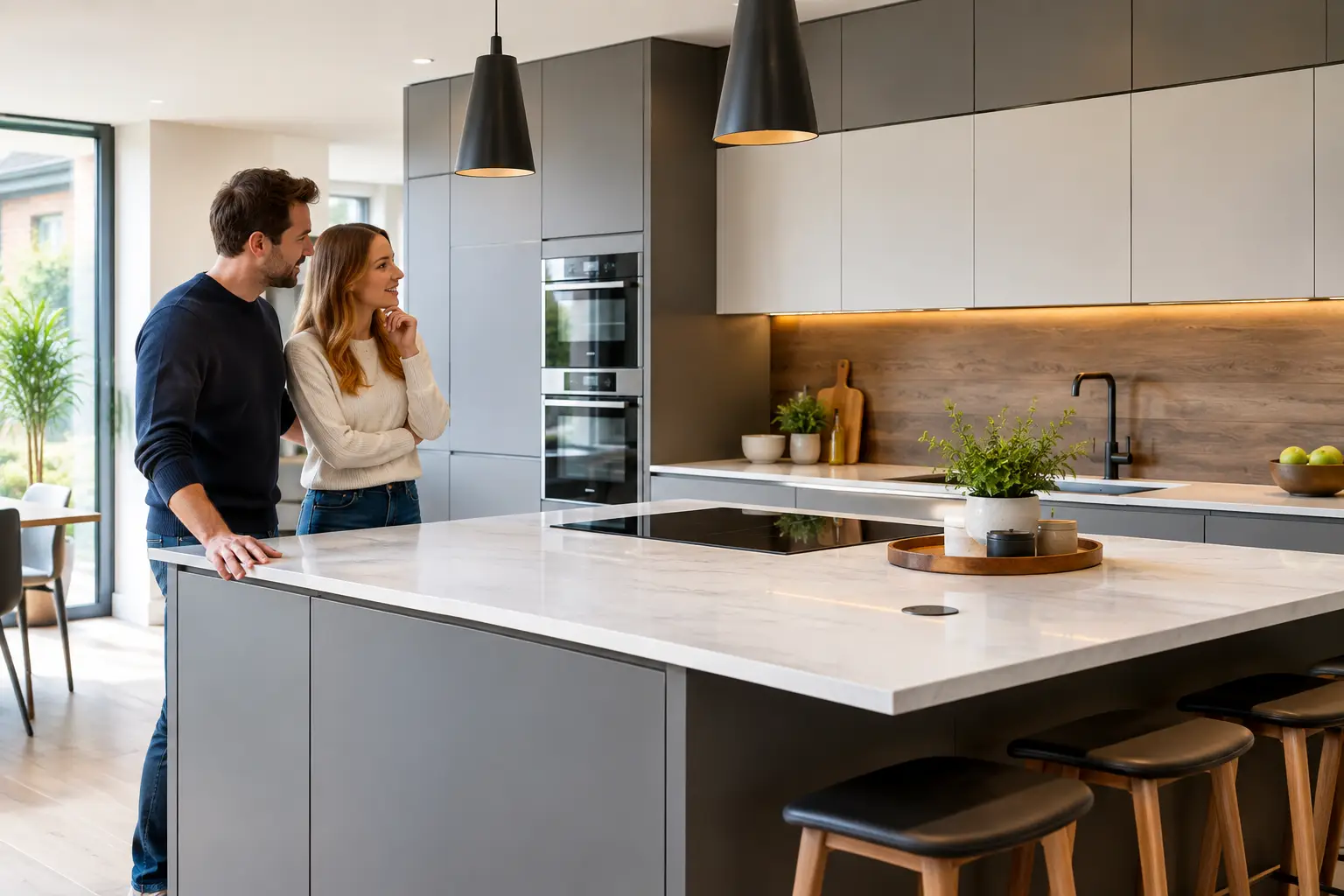
A kitchen quotation can look reassuringly simple until you try to compare it with another. One price may include delivery, internal storage, end panels and a fully specified appliance package; another may not. For homeowners considering German kitchens UK suppliers offer, the real question is not simply which door style looks best. It is whether the furniture, planning and service behind the drawing will stand up to the way you live and the realities of a British renovation.
German kitchen furniture has earned its reputation through precise manufacturing, carefully engineered storage and a disciplined approach to proportion. But it is not a single product category with one level of quality or one price. A well-planned Nobilia kitchen and a more extensively specified Schüller kitchen can both be excellent choices, provided the cabinetry and specification suit the room, budget and brief.
What distinguishes German kitchens in the UK?
The appeal begins with the furniture itself. German manufacturers typically produce modular cabinetry in highly automated factories, where carcasses, fronts, edge treatments and fittings are made to consistent tolerances. That consistency matters when a run of tall units must align precisely, when handleless rails need to meet cleanly, or when an island becomes the visual centre of an open-plan room.
It also supports practical longevity. Quality hinges, drawer runners and internal fittings are designed for repeated daily use, while the range of cabinet heights, depths and widths gives a designer more control over storage. Rather than filling a wall with a few broad cupboards and compromise panels, the layout can be calibrated around the room and its contents.
This does not mean every German kitchen automatically fits every project. A period property with uneven walls, shallow service voids or an awkward chimney breast requires careful surveying and sensible allowances. Factory-built furniture is precise, but the room may not be. Good planning accounts for that distinction before an order is placed, rather than expecting an installer to solve it on site.
Design discipline, not just a modern look
German kitchen design is often associated with handleless doors, matt finishes and calm, architectural colour palettes. Those are popular options, but the more useful principle is design discipline: a limited material palette, strong horizontal lines and a layout where every cabinet has a purpose.
That can work equally well in a compact London terrace, a family extension or a contemporary self-build. A pale wood-effect front may soften a large room; a darker lacquer can give an island real presence. The best choice depends on daylight, adjacent finishes, cleaning preferences and how the kitchen connects with the rest of the home.
For example, a handleless kitchen delivers a particularly clean elevation, but it needs considered opening positions and good-quality rail profiles. Traditional handles can be more forgiving in a busy family kitchen and may better suit a transitional interior. Neither route is inherently superior. The quality lies in resolving the detail well.
How to compare German kitchens UK suppliers quote
A headline price is a starting point, not a comparison. Ask for an itemised quotation that makes clear what has been allowed for, from cabinet ranges and front finishes to internal drawers, decorative panels, plinths, lighting and delivery. If appliances or worktops are included, their model references and specifications should be equally clear.
Cabinetry can look similar in a rendered image while differing meaningfully in the details. Check the carcass construction, available cabinet dimensions, drawer systems, door finish, edging and the amount of usable internal storage. Also establish whether the price reflects the layout as drawn, or a provisional allowance that will change later.
Worktops deserve their own scrutiny. A slim laminate, compact laminate, quartz and sintered stone can all create a refined result, yet they differ in cost, joins, fabrication requirements and care. A technical drawing should show where joints, upstands, overhangs and appliance clearances are expected, especially around islands and tall housings.
The same applies to integrated appliances. A beautifully composed bank of cabinetry can be undermined by an appliance chosen without considering ventilation, door configuration or niche dimensions. Integrated refrigeration, induction ventilation and tall ovens should be specified early enough for the furniture plan to accommodate them properly.
Value is not the same as the lowest initial price
Showroom overheads can add significantly to a kitchen price, particularly where expensive retail space and commission-led sales models sit behind the quotation. A direct, online design service can offer a different equation: factory-built furniture and specialist planning without the cost base of a traditional high-street studio.
That said, lower cost should not mean less clarity. A supplier should be open about who is manufacturing the kitchen, what warranty applies, how deliveries are managed and who remains responsible for the design detail. Direct factory supply is valuable only when it is paired with a well-managed process and a person who understands the project from first CAD plan to final order.
LindenHaus works exclusively with authorised Nobilia and Schüller furniture, pairing direct factory supply with senior designer-led planning. For many clients, the benefit is not simply a better price than a comparable showroom specification. It is continuity: one named specialist who can explain why a filler is required, whether a cabinet depth will work and what needs confirming before production.
Remote kitchen planning can be highly detailed
Buying a premium kitchen online can feel like a leap if you are used to browsing physical displays. In practice, the critical decisions do not happen by opening and closing a showroom drawer. They happen in the planning: measuring the space accurately, understanding services, refining the layout and reviewing the specification line by line.
A proper remote process should begin with the available information: architectural plans where relevant, room measurements, photographs, window and door positions, ceiling heights, boiler or utility constraints, and the location of existing or proposed services. A designer can then create a CAD plan that tests circulation, storage and appliance placement before anyone commits to furniture.
Photorealistic 3D visualisations are useful because they reveal balance and material relationships. They should not replace technical drawings, however. The plan needs to show cabinet widths, appliance housings, worktop depths and installation-critical dimensions. Material samples provide another essential check, particularly for matt lacquers, wood reproductions and worktop finishes that can appear different on a screen.
Build in time for the decisions that affect production
Made-to-order furniture rewards decisiveness at the right stage. Before placing an order, confirm appliance models, sink and tap choices, worktop material, handle or rail finish, lighting needs and any cabinetry around existing architectural features. Changes are far easier while the design is still in development than after factory production has begun.
It is also sensible to coordinate delivery around the installer and wider build programme. Most projects have a sequence: first fix services, flooring decisions, plastering, kitchen installation, templating and worktop fitting. A kitchen plan that ignores this sequence may be attractive on paper but expensive in practice.
Mainland-UK delivery, a clear manufacturer warranty and a five-year guarantee provide useful reassurance, but they do not remove the need for careful project management. Leave appropriate access for delivery, check room readiness and ensure your installer has the final technical information in good time.
The questions worth asking before you commit
Ask who manufactures the cabinetry and whether the supplier is authorised. Ask for the exact range and finish, not a broad description such as “German-style”. Ask what is included in the quoted furniture and what remains provisional. Finally, ask who will handle design queries if a detail changes during the project.
The answers reveal far more than a glossy image ever can. Premium kitchen buying should feel considered rather than pressured, with enough information to compare specifications fairly and enough design support to make confident decisions.
A good first step is to gather your room dimensions, a few photographs and an honest list of what does not work in your current kitchen. That gives a specialist designer something more valuable than a vague wish list: the practical brief for a kitchen that will earn its place in your home every day.
Planning a supply-only German kitchen?
We supply Nobilia and Schüller kitchens across the UK on a supply-only basis, with full design service, technical drawings and post-delivery support for your installer.