
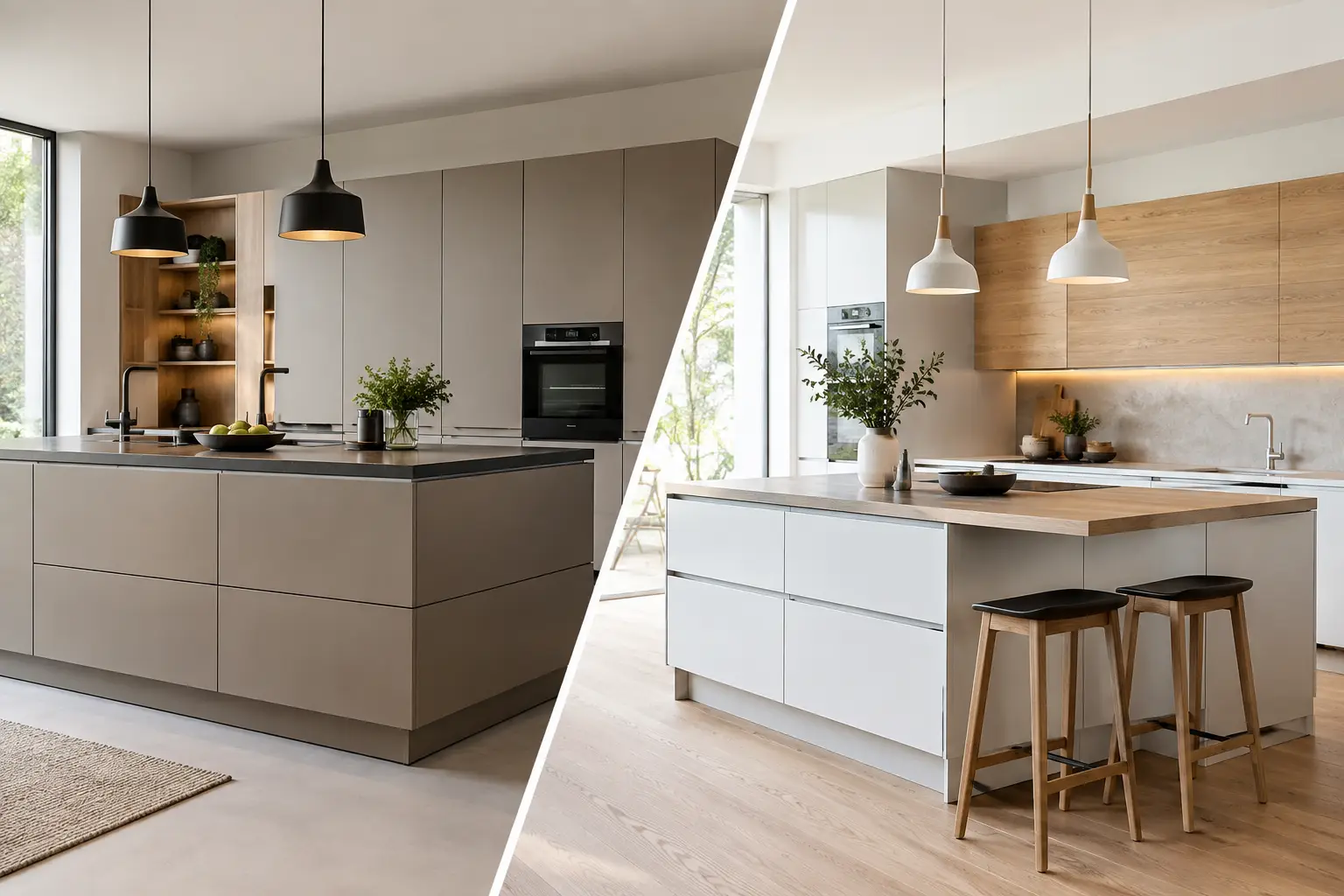
A kitchen quotation can make two German brands appear more alike than they are. Both Nobilia and Schüller produce precise, factory-made cabinetry with contemporary design credentials, but the Nobilia vs Schüller kitchens decision usually comes down to how far you want to take the specification. Your room, layout, finish expectations and budget matter more than the badge alone.
For a well-planned UK renovation, either can deliver an exceptional result. The better choice is the one that gives your designer enough freedom to solve the room properly, without paying for options that will not improve how the kitchen looks or works.
Nobilia vs Schüller kitchens: the essential difference
Nobilia is one of Europe’s largest kitchen manufacturers, known for bringing dependable German engineering, well-resolved storage and a broad choice of contemporary looks to a more accessible price point. It is a particularly strong fit for homeowners who want a considered, premium-feeling kitchen with clear value and a disciplined budget.
Schüller sits further up the specification ladder. Its collection offers greater scope for furniture-led planning, more material and colour choices, and more opportunities to create a tailored architectural look. That does not mean every Schüller kitchen costs dramatically more. It means there is more room to specify distinctive details, especially in larger spaces, open-plan projects and designs where cabinetry is intended to feel integral to the room.
Neither is a shortcut to a good kitchen. A poor layout remains a poor layout, whatever the door finish. The meaningful comparison is between like-for-like plans: cabinet types, internal fittings, door materials, worktop allowance, appliance integration and the finishing panels needed to make the installation look complete.
Where Nobilia makes most sense
Nobilia is often the sensible starting point for a renovation, extension or first major kitchen project. Its range is extensive enough to support modern handleless schemes, classic framed looks, textured timber effects, matt colours and practical family layouts without forcing the budget into premium territory.
The appeal is not simply price. Nobilia’s established furniture system makes it possible to plan efficiently around the realities of a British home: an awkward alcove, a utility room, a compact galley, a wide island or a run of tall cabinetry around integrated appliances. The outcome can feel highly individual when the proportions, colours and details are properly considered.
It is especially compelling when you want to allocate more of the project budget to the things you will use and see every day. That might mean better appliances, a more durable worktop, additional drawer storage, well-planned lighting or resolving the utility room at the same time as the kitchen.
There are limits, as there should be at this level. If your brief depends on a very particular veneer, an unusual lacquer colour, highly specialised cabinet configurations or a furniture-like island with distinctive detailing, the Nobilia range may narrow your choices sooner. That is not a quality issue. It is a question of design latitude.
When Schüller is worth the step up
Schüller is designed for projects where the cabinetry itself is a central design feature. Its wider finish palette and more expansive options allow a kitchen to move beyond a functional arrangement of units and become part of the interior architecture.
This is valuable in a large extension with sightlines into the dining or living area. You may want the same finish to continue across tall cabinetry and a media wall, a precise tonal match to flooring or wall finishes, or an island that reads as freestanding furniture rather than a bank of cupboards. Schüller gives a designer more tools to control those relationships.
The difference is often felt in the details. Consider a dark, super-matt kitchen where the quality of the surface, the edge treatment and the way panels meet matters just as much as the cabinet plan. Or a scheme combining textured wood, painted surfaces and discreet integrated appliances. These are the situations in which a broader palette and more furniture options can earn their place in the budget.
Schüller can also be a practical decision, not just an aesthetic one. A complex room may need a particular cabinet solution to preserve circulation, align a tall run neatly with an opening or avoid filling a visible gap with an oversized filler panel. More planning flexibility can improve the finished result and sometimes reduce compromises elsewhere.
Quality: do not confuse range position with reliability
Both manufacturers are respected German kitchen producers, and both are built around the advantages buyers expect from factory-made cabinetry: consistent production, engineered components and furniture designed as a coordinated system. With either brand, durability also depends on sensible specification, accurate site measurement, correct installation and how the kitchen is used.
A family kitchen needs different priorities from a low-use entertaining space. Deep drawers, practical internal organisers and an easy-care door surface may matter more than an exotic finish. Conversely, a design-led home may justify a higher-specification door or a more refined cabinet composition because it supports the whole interior.
Ask for the exact specification rather than relying on broad terms such as ‘premium’ or ‘luxury’. A clear quotation should identify the door range, cabinet configuration, visible panels, handles or handleless rail system, internal accessories and any non-standard items. This is the only reliable way to compare two designs fairly.
Price: compare the full room, not a headline figure
It is tempting to think of Nobilia as the lower-cost choice and Schüller as the expensive one. Broadly, that direction is fair, but it is not enough to guide a purchase. A straightforward Schüller design can be better value than a heavily upgraded Nobilia scheme, while a restrained Nobilia specification may free substantial budget for a quartz worktop and integrated appliances.
The strongest comparison starts with the same room plan and the same practical requirements. Keep the appliance allowance, worktop material, storage specification and installation scope visible. Then look at where the price changes and whether each change is meaningful to you.
Showroom quotations can obscure this by bundling services, promotional discounts and allowances into one headline number. A detailed, itemised furniture quotation is more useful. It shows what is genuinely included and makes it easier to decide whether a higher-specification finish, extra drawers or a more tailored cabinet arrangement represents good value.
For many homeowners, direct factory supply and remote design support can make the premium German kitchen route more attainable. LindenHaus combines CAD planning, photorealistic visualisations, material samples and technical drawings with furniture supplied from authorised manufacturers, without the overheads of a traditional showroom model.
The planning questions that decide it
Before choosing between the brands, establish what the room needs to achieve. How many people cook at once? Which appliances need to be integrated? Is the island primarily for prep, seating or storage? Where will everyday clutter go? Will tall cabinetry be visible from the living space?
Then consider how exacting the aesthetic brief is. If you have found a particular colour, texture or furniture detail that defines the scheme, test it early. A material sample and a realistic CAD visualisation are far more informative than a small online image. They reveal whether the finish works with natural light, flooring and the scale of the room.
It is also worth considering the project programme. Kitchen furniture is made to order, so the final design should be agreed only when the building work, services and appliance choices are sufficiently settled. Accurate technical drawings help your builder and installer prepare the room correctly, while delivery can be scheduled around the point at which the space is ready.
Choose the brand that leaves fewer compromises
Choose Nobilia when you want excellent German cabinetry, broad style choice and a tightly controlled budget. It is capable of producing polished, highly functional kitchens that feel far beyond standard off-the-shelf furniture.
Choose Schüller when the cabinetry must work harder as part of the architecture of the home, or when a more individual finish and greater design freedom will noticeably improve the result. It is often the right investment where the kitchen is visible across an open-plan space and expected to carry the visual character of the interior.
The most useful next step is not to ask which brand is best in isolation. Ask which layout, finish and specification will still feel right after years of weekday breakfasts, busy evenings and weekends around the island. A carefully developed plan makes that answer much clearer than a brochure ever can.
Planning a supply-only German kitchen?
We supply Nobilia and Schüller kitchens across the UK on a supply-only basis, with full design service, technical drawings and post-delivery support for your installer.