
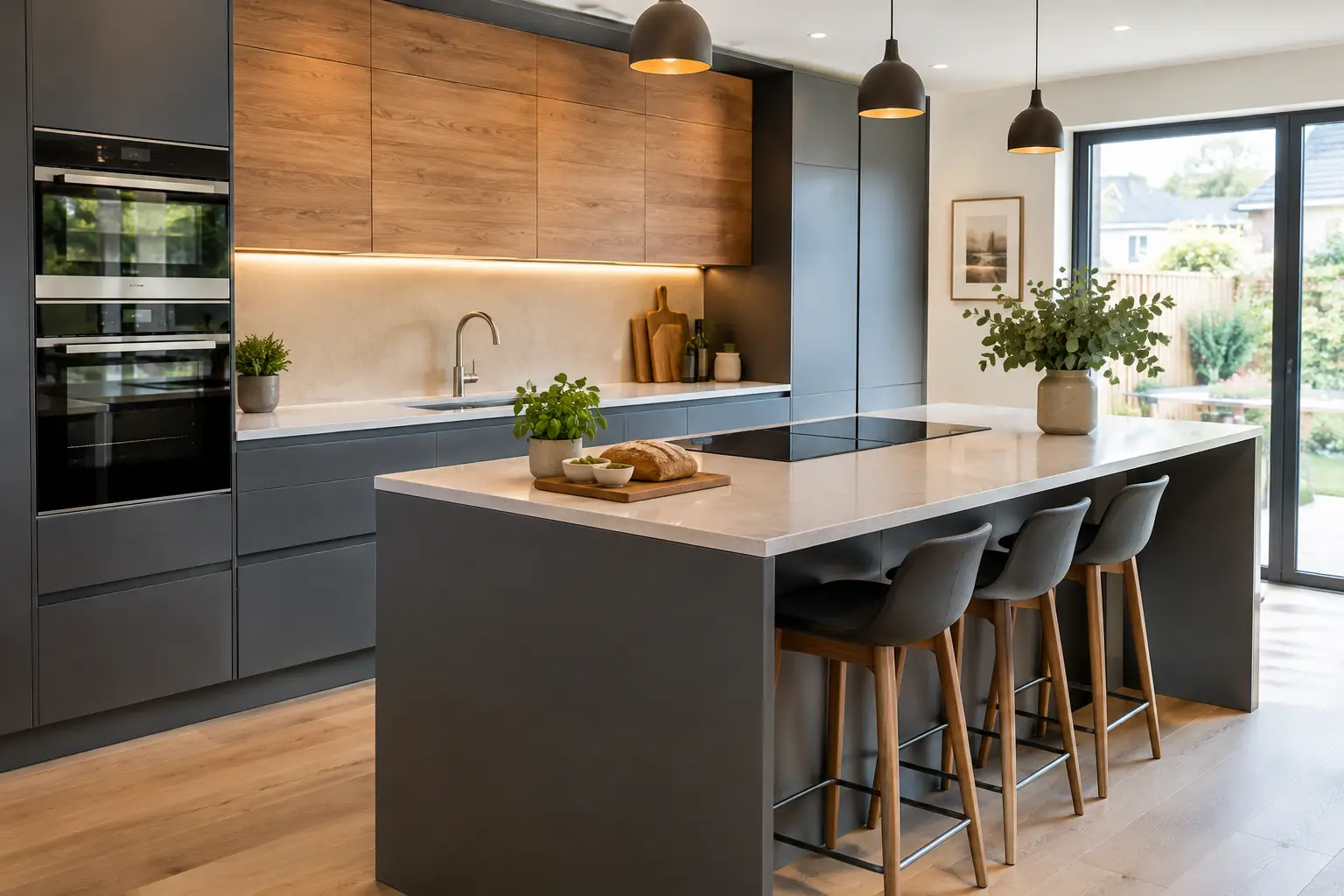
A kitchen can look excellent in a brochure and still fail the test that matters: the Tuesday evening when every drawer is open, the dishwasher is unloading and two people need the same worktop. German kitchens are built around making those everyday moments easier. Their appeal is not simply a clean-lined, contemporary appearance. It is a disciplined approach to cabinetry, storage, proportion and planning that suits carefully considered UK renovations, extensions and self-builds.
For homeowners comparing premium kitchen options, the useful question is not whether German furniture is automatically better. It is whether its construction, configuration and design language are right for the room, the budget and the way you live. Often, they are. But the detail matters.
What sets German kitchens apart?
German kitchen manufacturers are known for treating the kitchen as a coordinated furniture system rather than a collection of individual cupboards. Cabinets, drawers, internal storage, tall units, doors, plinths and panels are designed to work together in a wide range of widths, heights and finishes. That gives a designer more control over the final composition and less need for awkward fillers or visual compromises.
This system-led thinking is particularly valuable in UK homes, where room shapes are rarely straightforward. A Victorian terrace may have a chimney breast, uneven walls and limited natural light. A new extension may have generous glazing but require a kitchen that relates well to a dining area and garden. The cabinetry needs to respond to those conditions, not force the room into a standard layout.
The visual result is usually calm and purposeful. Handleless rails, slim worktops, tall banks of cabinetry and carefully aligned shadow gaps can create a refined architectural feel. Yet a German kitchen does not need to be minimalist. Warm timber effects, matt lacquer finishes, fluted detailing, framed doors and darker colours can make the scheme feel softer, more traditional or more expressive where the property calls for it.
German kitchens are planned as systems
The quality people notice first is often the door finish. The quality they live with is usually in the cabinet underneath it.
Cabinet construction and adjustment
Premium German cabinetry is factory-produced to consistent tolerances, with engineered board construction, durable edging and hardware designed for repeated daily use. Doors and drawers are adjustable, allowing an installer to achieve crisp alignment once the furniture is fitted. This matters after the kitchen has met the realities of a British building, where floors and walls may not be perfectly level or square.
A cabinet specification should be compared carefully rather than assumed. Look at the carcase thickness and finish, the quality of the back panel, shelf loadings, drawer runners, hinges and the adjustment available during installation. A beautiful front paired with a lesser cabinet is not equivalent to a fully considered furniture system.
Storage that earns its space
Wide pan drawers are one of the most practical features of a well-planned German kitchen. They make pans, plates, dry goods and utensils visible and accessible without kneeling to search inside deep base cupboards. Tall larders can organise food and small appliances vertically, while internal drawer systems keep cutlery, spices and recycling from becoming an afterthought.
More storage is not always the answer. A room filled with tall units can feel heavy, especially where light is limited. Equally, a large island with no useful internal organisation is wasted potential. Good CAD planning tests the balance between storage capacity, worktop space, circulation and the visual weight of the furniture before anything is ordered.
Flexible sizes, better proportions
German ranges commonly offer a broad choice of cabinet widths and heights. That makes it easier to centre an induction hob, align a sink with a window, create an uninterrupted run of drawers or build a tall-unit wall around integrated appliances. The aim is not to avoid every filler panel at all costs. It is to place necessary adjustments where they are discreet and retain a deliberate rhythm across the design.
This flexibility also helps when planning around contemporary appliance choices. An integrated fridge freezer, compact oven, coffee machine, wine cooler or tall pantry each has ventilation, access and service requirements. These should be resolved at the design stage, not left for an installer to negotiate on site.
A good layout matters more than a fashionable finish
A German kitchen will not compensate for a poor plan. The most successful schemes begin with how the household actually uses the room: where shopping arrives, where breakfast happens, whether children do homework at the island, how often people entertain and which appliances are used every day.
An L-shaped kitchen can be highly efficient in a smaller extension, particularly when it combines long drawer runs with a compact dining table. A galley layout may be the best use of a narrow room if it preserves a clear route through the space. An island works well when there is enough clearance around it - not simply because it looks desirable in a visualisation. In many homes, a peninsula provides the sociable seating and extra storage of an island while using less floor area.
The established work triangle still has value, but modern kitchen use is more varied. Consider separate zones for cooking, preparation, cleaning and hot drinks. Keep the dishwasher near crockery storage, place bins close to preparation space and allow a sensible landing area beside ovens, fridges and the hob. These decisions are modest on a plan and significant in daily life.
Choosing German kitchens for a UK project
A remote design process can work exceptionally well when it is detailed. Accurate room dimensions, photographs, ceiling heights, window and door positions, boiler locations, electrical points and drainage information allow the first CAD plan to start from the right place. For larger projects, architectural drawings are useful, but they do not replace a final site measure before installation.
Material samples remain important. Screen images cannot reliably show the undertone of a pale grey door, the texture of a wood-effect finish or the sheen of a lacquer. Samples should be viewed in the actual room, in daylight and under evening lighting, alongside proposed flooring, wall colours and worktop choices.
This is also where one named designer makes a practical difference. A specialist who understands the brief from the initial conversation can explain why a cabinet width has changed, how an appliance affects a tall-unit run or where additional filler is required for a wall that is out of square. Continuity prevents the familiar problem of repeating decisions to several people while the specification changes between conversations.
For a UK customer, confirm the delivery arrangement early. Factory-built furniture is typically delivered as a coordinated consignment, so access, storage and timing with the installer should be planned well before the delivery date. A project with plastering, flooring and worktop templating still underway needs a realistic programme, not a hopeful one.
Value means comparing specifications, not door prices
German kitchens occupy a wide price range. Nobilia can offer carefully engineered, design-led furniture at a compelling level, while Schüller provides additional scope in finishes, dimensions and premium detailing. Neither should be judged by a headline price alone.
A useful comparison sets like against like: the exact cabinet configuration, drawer specification, internal accessories, door material, panels, plinths, handles or handleless system, worktop, appliances, delivery and warranty. One quotation may look lower because it excludes end panels, internal drawers or the finishing pieces required to make the design work. Another may include more than the project needs.
The direct-from-factory model can change the value equation. By reducing high-street showroom overheads while retaining experienced design support, LindenHaus can offer authorised Nobilia and Schüller cabinetry at pricing typically 20-30% below comparable showroom specifications. The point is not to buy cheaply. It is to direct more of the budget towards the furniture, planning and materials that remain visible and useful for years.
There are trade-offs. Made-to-order cabinetry requires decisions to be settled before production, and lead times need to be built into the renovation schedule. If the project is likely to change repeatedly after walls are opened up, a final survey and clear sign-off are essential. For customers who need an immediate, off-the-shelf solution, factory-made furniture may not be the right route.
The details that protect the finished result
A well-designed kitchen also needs a clear technical handover. Installation drawings should identify cabinet positions, service voids, appliance requirements, worktop details and elevations. The installer then has a reliable reference, rather than working from a visual alone. Photorealistic 3D images are valuable for judging colour, proportion and sightlines; technical drawings are what turn the approved concept into a buildable room.
Ask how warranty and aftercare are handled, particularly when buying online. Manufacturer provenance, a written furniture guarantee and a clear route for resolving a damaged or missing component all provide reassurance. These are not glamorous parts of a kitchen purchase, but they are part of its value.
The right German kitchen should feel less like a statement piece and more like an unusually well-resolved part of the home. Start with the room, the routines and the non-negotiables, then let the cabinetry system do what it was designed to do: make every line, drawer and working area earn its place.
Planning a supply-only German kitchen?
We supply Nobilia and Schüller kitchens across the UK on a supply-only basis, with full design service, technical drawings and post-delivery support for your installer.