
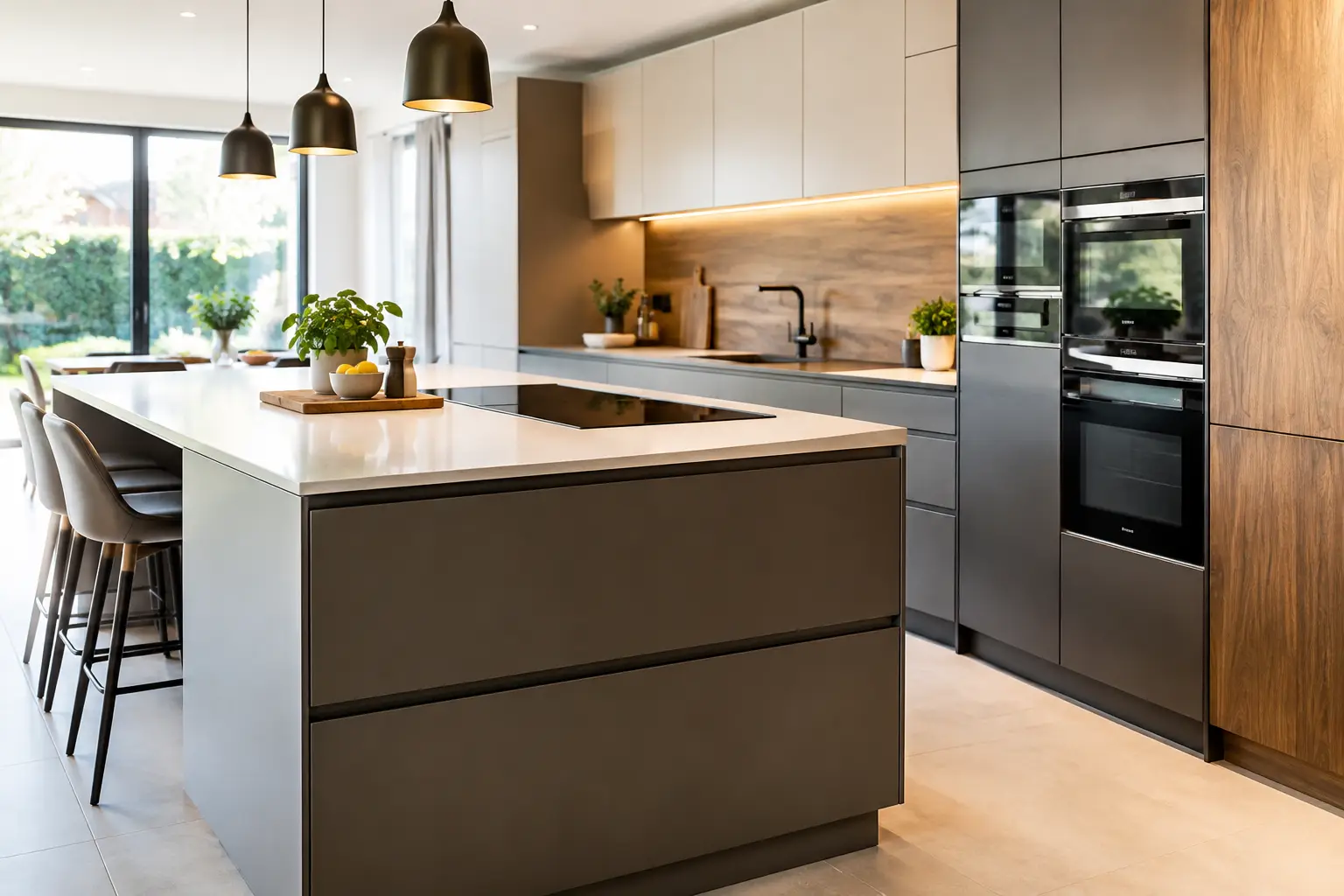
A German kitchen quotation can look deceptively similar from one brand to the next: handleless doors, tall appliance housings, a pale oak finish and a dark worktop. The real differences sit behind the image. Cabinet construction, the depth of the range, finish options, lead times and how well the furniture can be planned around a UK room all affect the result. That is why choosing between the best German kitchen brands should begin with your project requirements, not a showroom display.
For a renovation, extension or self-build, the right brand is the one that gives your designer sufficient flexibility without spending money on options that will not improve how your kitchen works. German furniture is respected for its orderly engineering, precise manufacturing and modern design language, but it is not one single standard of quality or price.
What makes German kitchen brands distinctive?
German manufacturers tend to approach kitchens as coordinated furniture systems. Base, wall and tall units are produced to consistent dimensions, with carefully developed cabinet interiors, door programmes, plinths, panels and appliance housings. This makes it possible to create a composed run of cabinetry rather than assembling unrelated elements around the room.
The design influence is often associated with Bauhaus principles: useful storage, restrained detailing and proportion before decoration. In practical terms, that might mean deep pan drawers for everyday cookware, a tall unit that places ovens at a comfortable height, or an integrated dishwasher concealed within a continuous door finish.
That said, a premium-looking German kitchen is only as good as its plan. A poorly positioned island, insufficient worktop landing space or an appliance bank that dominates a modest room will not be rescued by a premium door. CAD planning, technical drawings and realistic visualisations are therefore as important as the manufacturer name on the furniture.
Best German kitchen brands: how the main names compare
The most suitable brand depends on budget, desired level of customisation and the character of the room. These are some of the names UK homeowners are most likely to encounter when comparing German kitchens.
Nobilia: breadth, value and dependable modern design
Nobilia is one of Europe’s largest kitchen manufacturers and a strong choice for homeowners who want factory-made German cabinetry with substantial choice and sensible value. Its range covers contemporary handleless schemes, modern framed looks, wood-effect finishes, matt colours and more traditional details, making it adaptable across extensions, family homes and compact urban kitchens.
Its scale is a practical advantage. Nobilia offers a wide set of cabinet types, storage solutions and finish combinations, allowing a good designer to resolve awkward corners, utility areas and appliance integration without resorting to expensive bespoke joinery. It is particularly compelling where the brief calls for a polished, durable kitchen with a controlled budget.
The trade-off is that Nobilia operates within a defined, modular system. That is generally a strength for price and reliability, but a project requiring highly unusual dimensions or an exceptionally niche material may need a more design-led or bespoke route. Careful planning can often make the standard system feel entirely tailored.
Schüller: elevated finishes and greater design expression
Schüller occupies a more premium position, with a broader emphasis on refined finishes, sophisticated colour palettes and flexible contemporary planning. It is well suited to design-conscious homeowners who want the clean architectural look of a German kitchen, while having more scope to make the scheme feel personal.
The collection is particularly strong for open-plan spaces, where the kitchen must relate convincingly to dining and living areas. Tall cabinetry can be designed as furniture-like blocks, while coordinated sideboards, shelving and media elements help carry the finish beyond the working zone. Integrated appliances and carefully chosen worktops become part of a complete interior composition rather than isolated purchases.
Schüller usually commands a higher investment than entry-level German furniture, and rightly so when the specification takes advantage of its range. It will not always be the best value if the brief is a straightforward utility kitchen or a very simple rental refurbishment. For a long-term home with a clear design ambition, however, the additional choice can be worthwhile.
Leicht, Häcker and Rotpunkt: strong alternatives for specific briefs
Leicht is widely associated with high-end, architectural kitchen design. Its appeal lies in the visual precision of its systems, material-led collections and ability to create a very considered fitted-furniture effect. It is often chosen for larger, design-led projects, though pricing can move upward quickly as specifications become more ambitious.
Häcker has a broad reputation for reliable German manufacturing and offers different product tiers. It can be a sensible option where a homeowner wants contemporary furniture with plenty of choice, although the exact value depends heavily on which collection is quoted and how the retailer has specified it.
Rotpunkt is known for contemporary design, distinctive finishes and a focus on environmentally minded production. Its offer can be attractive if colour, texture and a less conventional aesthetic are central to the brief. As with all brands, compare like for like: cabinet ranges, internal accessories, panels, delivery and fitting preparation can vary significantly between quotations.
Poggenpohl and luxury-led names: when the brand is part of the brief
At the top end of the market, brands such as Poggenpohl are often selected as much for heritage, statement design and exclusivity as for cabinet function. They can produce remarkable results in architect-designed homes, particularly where the kitchen is intended to be a focal piece within a wider interior scheme.
For many UK projects, though, the additional spend may not translate into proportionately better day-to-day usability. If your priorities are excellent storage, durable doors, integrated appliances and a well-resolved layout, a carefully specified Nobilia or Schüller kitchen can deliver the qualities that matter most without paying chiefly for badge value.
Compare the specification, not just the brand name
A meaningful comparison starts with an itemised quotation. One proposal may include drawer organisers, end panels, appliance housings, delivery and detailed planning; another may show a lower headline figure while leaving some of those elements to be added later. Neither is automatically better, but they are not directly comparable until every component is visible.
Ask to see the cabinet dimensions, door finish, handle or rail system, interior specification, worktop allowance and appliance assumptions. Check whether tall units include the relevant appliance ventilation requirements, whether your chosen fridge and dishwasher have been correctly matched to the furniture, and whether panel thicknesses and visible side finishes have been allowed for. These details shape both cost and installation quality.
Material samples deserve attention too. A photographed finish can appear warmer, cooler or more textured on screen than it does in a north-facing kitchen. Reviewing samples alongside flooring, paint and worktop choices is a simple way to avoid an expensive mismatch.
Why planning matters more in UK homes
German cabinetry is designed around a system, while British homes are often defined by irregular walls, chimneys, service runs and extensions that have not yet been built. The designer’s job is to bridge that gap. A strong plan accounts for filler panels, opening clearances, extractor routing, window lines, ceiling heights and the practical route for bringing units into the property.
This is especially relevant when buying remotely. A high-touch digital process should still include measured plans, a thorough discussion of how you cook and live, photorealistic 3D visualisations, and technical drawings that your builder or installer can work from. One named specialist throughout the project reduces the risk of decisions being lost between sales, design and order stages.
LindenHaus focuses on authorised Nobilia and Schüller furniture because these two manufacturers give UK homeowners a useful balance: dependable German production, broad planning capability and premium design options at a level that remains practical for many renovation budgets. Direct factory supply can also remove some traditional showroom overhead, provided the service still includes detailed design support, clear delivery planning and manufacturer-backed warranty cover.
Choosing the right route for your project
Start with the room, not the brochure. A busy family kitchen may benefit most from generous drawers, easy-clean fronts and a durable worktop. An open-plan extension may justify a more expressive Schüller finish and a furniture-style tall run. A compact galley kitchen may gain more from intelligent appliance placement and full-height storage than from an island squeezed into the wrong space.
Give your designer a realistic budget early, including appliances, worktops, delivery, installation and building works. That makes it possible to direct investment towards the details you will use every day, rather than presenting a beautiful scheme that requires awkward compromises later.
The best German kitchen brand is rarely the most expensive name in the room. It is the one whose cabinetry, finish range and planning system allow your kitchen to fit the way you live, with every visible and technical detail properly resolved before the factory order is placed.
Planning a supply-only German kitchen?
We supply Nobilia and Schüller kitchens across the UK on a supply-only basis, with full design service, technical drawings and post-delivery support for your installer.