
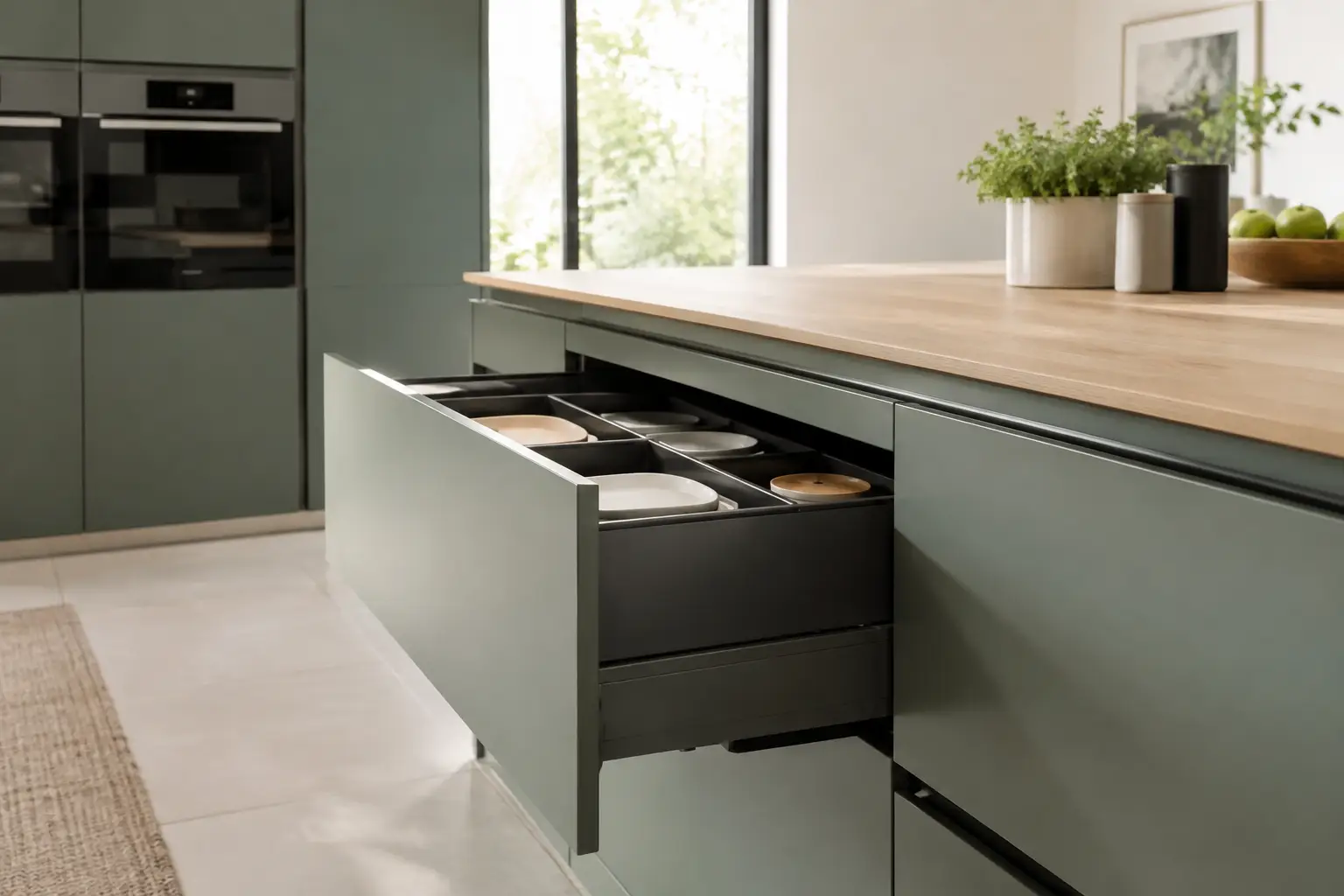
A kitchen can look convincing in a brochure yet disappoint once it is loaded with pans, opened hundreds of times a week and fitted around walls that are not quite square. That is why Nobilia cabinet construction deserves attention before colours, handles or worktops. The visible finish matters, but the engineering behind each unit has a greater bearing on day-to-day use, installation quality and long-term confidence.
What Nobilia cabinet construction actually means
Nobilia kitchens are made as a coordinated furniture system rather than as a collection of separately built cabinets. Base, wall and tall units are manufactured in Germany to defined dimensions, supplied factory-built and designed to work together with the chosen doors, drawers, internal storage, appliances and worktop arrangement.
For a UK renovation, that distinction is useful. A factory-built cabinet arrives with its structure already set, rather than relying on an installer to assemble every carcase on site. This supports consistent alignment and saves time during fitting, although it also makes accurate CAD planning and a properly measured room essential. Made-to-order furniture leaves less scope for casual last-minute changes than off-the-shelf units.
Nobilia uses engineered wood boards for its carcases rather than solid timber. This is standard for quality contemporary fitted kitchens: it creates stable, precisely machined components that accept hinges, runners and fixings consistently. Solid wood may sound more premium, but it can move with changes in temperature and humidity. What matters here is board specification, edge finishing, joinery and how the furniture performs as a complete unit.
The Nobilia cabinet carcase: where durability begins
The carcase is the structural shell behind the door or drawer front. Nobilia cabinet construction typically uses 16 mm board for the principal carcase components, with an 8 mm rear panel within the cabinet structure. These are practical specifications, not marketing theatre. They provide a firm platform for shelves, drawer runners and wall-fixing hardware while keeping cabinetry proportionate and manageable for installation.
Edges are equally significant. Exposed board edges need a durable, neatly applied treatment to protect the core material from everyday moisture and knocks. This matters most around sink units, integrated dishwashers and areas close to kettles or boiling-water taps. No timber-based cabinet is invulnerable to a persistent leak, but good edge sealing and prompt attention to spills give the furniture its best chance of a long service life.
Factory-built accuracy has a practical benefit
A cabinet that is square when it leaves the factory makes it easier to create disciplined door lines and even drawer gaps across a run of units. It also gives the installer a reliable starting point when levelling cabinets over an uneven floor or accommodating a wall that drifts out of true.
That does not mean the furniture installs itself. The quality of fitting remains critical, particularly for tall banks, handleless designs and kitchens with full-height panels. Cabinets must be levelled, correctly fixed, joined together and supported appropriately beneath heavy stone or ceramic worktops. Good construction and good installation are partners, not alternatives.
Doors and fronts are separate from the cabinet structure
One source of confusion is the difference between a carcase and a front. A matt lacquer-look door, a textured wood reproduction and a high-gloss front can all be fitted to the same underlying cabinet system. The front determines much of the kitchen's visual character and the way it feels to touch; the carcase and hardware determine much of its working behaviour.
This is why comparing two kitchen quotations by door appearance alone can be misleading. Similar-looking flat-fronted doors may conceal very different drawer arrangements, shelf systems, panel details, appliance housing options and installation allowances. A useful comparison should show the cabinet type, front range, handle or rail system, internal equipment and all visible finishing panels.
The right front is therefore partly a lifestyle decision. A super-matt finish can suit a calm, architectural scheme but may show fingerprints differently from a textured surface. A wood-effect front brings warmth and visual depth, while a lighter plain door can make a compact UK kitchen feel more open. Material samples are valuable because colour shifts considerably between a screen, a large door and the daylight in your own room.
Hinges, drawers and storage do the daily work
A kitchen is opened and closed far more often than it is admired from across the room. Nobilia's furniture system uses adjustable hinges and drawer runners with soft-close operation, allowing the fitted kitchen to be fine-tuned for consistent reveals and quiet movement. Adjustment matters because settlement in a new extension, changes in floor level or normal use can occasionally require minor refinement.
Full-extension drawers are often a better use of a base cabinet than a conventional door with shelves. They bring cookware and food storage forward into view, reducing the need to reach into the back of a deep unit. However, drawers are not automatically the best answer everywhere. A sink cabinet needs to accommodate plumbing, while a wide pan drawer may be less practical in a very narrow galley layout.
Internal organisation should be planned around real habits rather than added simply because it appears sophisticated in a visual. Cutlery trays, pull-outs, recycling systems and tall larder mechanisms can improve a kitchen markedly when they solve a genuine problem. They also add cost, so a well-designed mix of drawers, shelves and a few carefully chosen accessories often represents better value than equipping every cabinet to its limit.
Construction needs to suit the room, not just the catalogue
German kitchen cabinetry is designed around modular dimensions, which is one reason it can produce such orderly layouts. Yet British homes frequently introduce complications: chimney breasts, awkward returns, service pipes, sloping ceilings and older walls that do not run straight. A strong plan uses the cabinet system intelligently while allowing for fillers, end panels, scribing and sensible service access.
Appliance housings deserve particular care. An integrated fridge, dishwasher or oven is not simply placed inside a gap. It needs the correct cabinet, ventilation provision where specified, door configuration and clearance for opening. The same applies to worktops: a thick stone surface, a slim compact laminate and a timber worktop each influence upstands, appliance heights and finished working levels differently.
This is where detailed CAD planning earns its place. It can establish cabinet widths, appliance positions, worktop joints and sightlines before the order is released to the factory. A photorealistic visual is helpful for judging proportion and colour, but technical drawings are what help an installer prepare electrics, plumbing, extraction and wall conditions correctly.
What to check when comparing a Nobilia specification
Ask for an itemised quotation that makes the furniture specification clear. Price differences are often explained by what has been omitted, simplified or left for the installer to provide later. Four checks are especially worthwhile:
- Confirm whether cabinets are supplied factory-built and identify the carcase construction included in the quotation.
- Check the drawer, hinge and internal-storage specification rather than assuming every base unit contains premium pull-outs.
- Establish which panels, fillers, plinths, cornices or lighting profiles are required to finish the design properly.
- Review appliance housings, worktop support, delivery arrangements and manufacturer warranty terms alongside the cabinet price.
A lower quotation is not necessarily poor value, and a higher one is not automatically better. The meaningful comparison is like for like: the same number of cabinets, equivalent fronts, matching storage, similar worktop scope and the same level of design and technical support.
A considered route to a better-fitted kitchen
Remote kitchen buying can work very well when it is supported by precise information and one specialist who understands the project from first layout to final order. At LindenHaus, CAD plans, itemised specifications, samples and technical drawings are used to make the furniture system understandable before production begins, not after it arrives.
The most useful next step is to look beyond the showroom door sample. Ask how the cabinets are built, how they will be fitted in your room and whether the storage plan supports the way you actually cook, clear away and live. Those answers will shape a kitchen that still feels considered long after the novelty of a new finish has passed.
Planning a supply-only German kitchen?
We supply Nobilia and Schüller kitchens across the UK on a supply-only basis, with full design service, technical drawings and post-delivery support for your installer.