
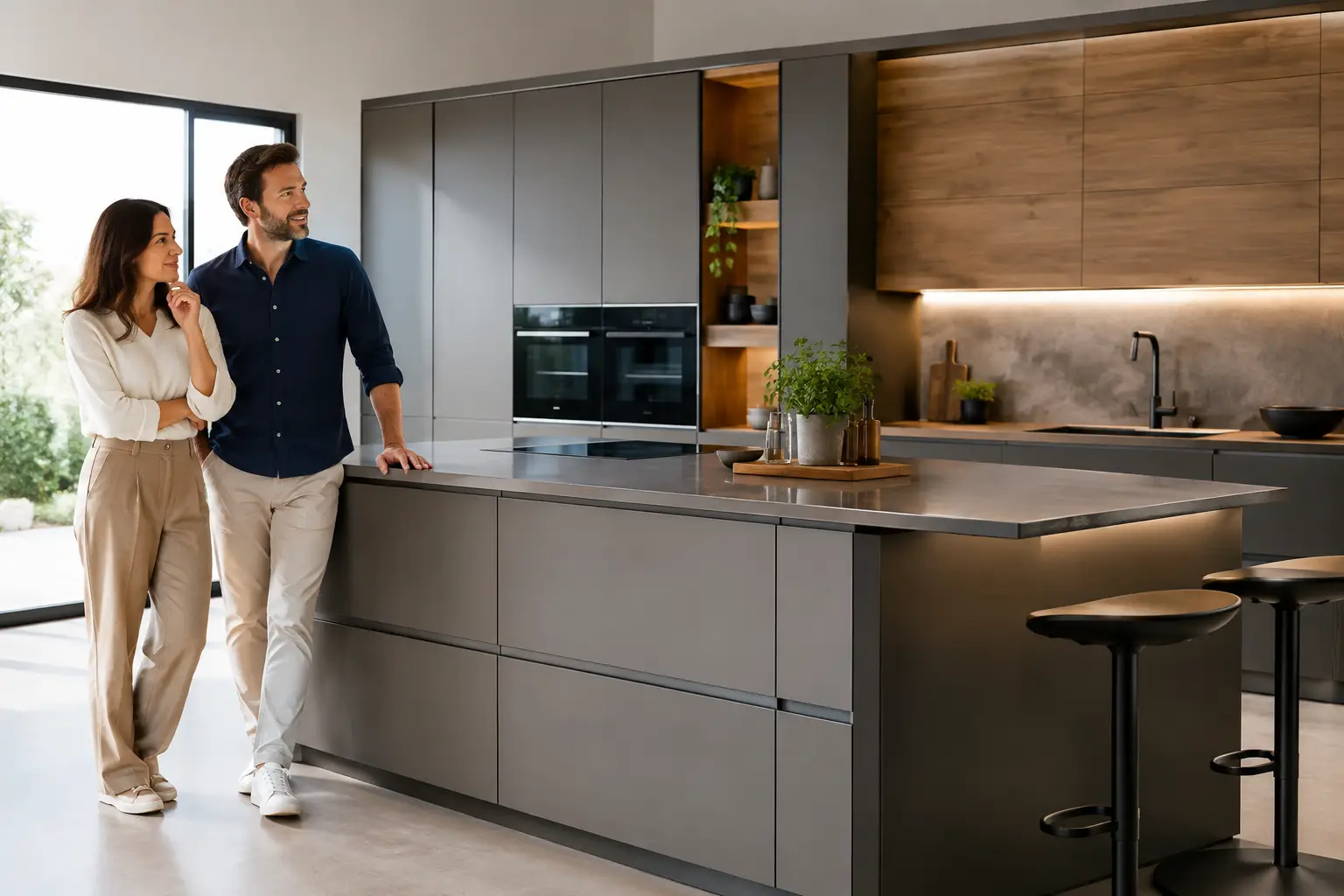
A tall bank of cabinetry can look immaculate on a showroom wall and still disappoint once it has to accommodate the kettle, recycling, school bags and daily cooking. Schüller kitchen quality is best judged in the details that remain after the styling has become familiar: how the furniture is made, how accurately it fits the room and how well the specification suits the way you live.
For UK homeowners comparing premium German kitchens, Schüller sits in a considered part of the market. It offers a broad design language, from calm matt modern schemes to textured timber effects and architectural handleless layouts, but quality is not simply a badge on the door. The final result depends on the collection selected, the internal fittings, the finish, the plan and the standard of installation.
What defines Schüller kitchen quality?
The starting point is industrially manufactured cabinetry rather than individually site-built furniture. Schüller kitchens are made to order in Germany, with components engineered to work as a coordinated system. Carcases, fronts, drawers, hinges, panels and tall units are designed around repeatable production tolerances. That consistency matters when a kitchen includes long runs, handleless reveals, stacked appliance housings or an island visible from several angles.
The furniture is supplied as factory-built cabinetry, which can reduce the variables involved in assembling numerous cabinets on site. It does not remove the need for careful room preparation, however. A well-made unit still needs a level floor, square walls where possible and an installer who understands how to scribe end panels, align doors and protect expansion gaps around walls and worktops.
Quality also shows in the practical components used every day. Smooth-running drawers, controlled door closing and properly specified internal storage make a greater difference over ten years than an impressive door sample alone. The best way to assess this is not to ask whether a drawer opens smoothly in principle, but to consider its job. Deep pan drawers under a hob, a pull-out larder storing tins, and a bin system used several times a day place very different demands on the furniture.
A system, not just a set of doors
A Schüller kitchen can be configured across different product collections and price levels. This is useful, but it means a quotation needs reading line by line. A more accessible collection may provide excellent engineering and contemporary finishes, while higher-specification options can broaden the choice of dimensions, materials, detailing and interior equipment.
That flexibility is a strength for a renovation or extension. It allows the visible design to remain coherent while investment is directed where it will be felt: perhaps wider drawers in the cooking zone, a better-organised pantry cabinet or more refined handleless detailing on an island. It also means two kitchens described simply as “Schüller” may not be directly comparable.
Materials and finishes: where expectations need context
Door finish is often the first quality cue a customer notices. A lacquered matt front, for example, feels different from a melamine-based surface, and a real veneer has a different character from a timber reproduction. Neither is automatically the right choice. The most suitable material depends on the look you want, the amount of natural light, cleaning habits, budget and how heavily the kitchen will be used.
Melamine and laminate-style surfaces can be highly practical for busy homes. They tend to offer convincing decor options, consistent colour and a reassuringly low-maintenance finish. Lacquered fronts can create a more tailored, refined appearance, particularly in soft neutral shades, but deserve appropriate care. Dark matt doors may show marks more readily than a textured mid-tone finish, while high-gloss surfaces can reveal scratches or smears in strong light.
Edge treatment deserves attention too. It is one of the quieter signs of cabinetry quality because it influences both appearance and resilience around doors and drawer fronts. Ask to see material samples in your own home rather than choosing under artificial showroom lighting. A sample lets you judge undertones against flooring, paint, brickwork and daylight, and it gives a clearer impression of texture than a screen image ever can.
The carcase is part of the finish
The interior colour, shelf thickness, edging and back panel construction may not be the exciting part of a kitchen brief, but they matter once doors are open. Consider how the cabinet interiors will look beside open shelving, glass units or a visible utility run. More importantly, check that shelves, drawer boxes and tall-unit internals are specified for what they will carry.
This is particularly relevant for UK projects where a compact room is expected to do several jobs. A tall cupboard may need to hold a coffee machine, air fryer, cleaning equipment and groceries. A design that looks pared back externally needs disciplined internal planning to avoid becoming inconvenient in everyday use.
Precision planning matters as much as factory engineering
German cabinetry is often associated with clean lines and disciplined proportions. Those qualities are only convincing when the plan is equally disciplined. A 20mm discrepancy at a wall, an appliance that opens into a walkway, or an island without enough circulation space can undermine an otherwise premium specification.
A proper CAD plan should resolve more than the cabinet list. It should test working clearances, door and drawer openings, appliance ventilation requirements, service positions, ceiling height, window reveals and worktop overhangs. Technical drawings are especially valuable where a builder, electrician, worktop fabricator and kitchen installer are all working to different stages of a programme.
For remote kitchen buying, this level of planning is the reassurance that replaces a traditional showroom visit. Photorealistic visuals help assess colour balance and overall mood, but dimensioned drawings and an itemised quotation are where the real decisions are made. They reveal whether the proposed quality is in the furniture itself or merely in the image.
Where a Schüller specification can add value
Schüller is often a strong fit when you want a tailored, architectural layout without commissioning fully bespoke joinery. The manufacturer’s range of cabinet sizes and design options can make it possible to create a composed wall of tall furniture, a practical utility room or a carefully detailed open-plan kitchen with fewer visible compromises.
There are limits. If your room has exceptionally irregular walls, a listed-building constraint, or a requirement for one-off cabinetry built around unusual architectural features, bespoke joinery may be the better route for part of the project. Equally, choosing the most premium front does not compensate for inadequate storage or an undersized preparation area.
Integrated appliances are another area where planning affects perceived quality. A kitchen should be designed around the precise appliance models, not generic placeholders. Appliance housings, ventilation, door alignment and service access all need checking before furniture is ordered. This avoids the costly late-stage changes that can turn a well-priced kitchen into a compromised installation.
Questions to ask before comparing quotations
When comparing a Schüller proposal with another German kitchen or a high-street studio quote, look beyond the headline total. Four areas are worth checking carefully:
- Which collection, front material and carcase specification are included?
- Are drawers, internal accessories, end panels, lighting details and handleless rails fully priced?
- Have worktops, appliances, delivery, installation requirements and site measurements been clearly separated?
- Do the drawings show the exact appliance models, service allowances and room dimensions?
These questions are not about finding faults in a quotation. They make it possible to compare like for like. A lower price can reflect efficient direct supply and lower showroom overheads, but it can also reflect omitted panels, basic storage or provisional elements that will return later as extras.
An authorised specialist should also explain the manufacturer warranty, lead time and delivery process in plain terms. For a made-to-order kitchen, delivery needs to be coordinated with site readiness, the installer and worktop templating. The furniture may be excellent, but the project experience depends on getting that sequence right.
A better way to judge the investment
The most persuasive evidence of quality is a specification that makes sense on paper and in your home. Look for cabinet dimensions that use the room intelligently, materials that suit your household, hardware matched to daily use and drawings detailed enough for your trades to follow with confidence.
At LindenHaus, that means working with one named kitchen specialist through CAD planning, material samples, itemised pricing and technical drawings, rather than treating the kitchen as a bundle of attractive doors. Direct factory supply can also make premium Schüller cabinetry more accessible than a comparable showroom specification, without reducing the attention paid to the plan.
Choose the finish you will still enjoy on an ordinary Tuesday morning, specify storage for the things you actually own, and give the installation team a plan precise enough to do the furniture justice. That is where Schüller kitchen quality becomes a kitchen that continues to work beautifully long after the project photographs have been taken.
Planning a supply-only German kitchen?
We supply Nobilia and Schüller kitchens across the UK on a supply-only basis, with full design service, technical drawings and post-delivery support for your installer.